Maths › Algebra and functions
Algebra and functions
The toolkit the whole course runs on: powers and roots handled exactly, quadratics read fluently, and functions bent, combined and undone.
Years 12-13 · 8 topics.
- Indices and surds
- Quadratic functions
- Simultaneous equations and inequalities
- Polynomials and the factor theorem
- Graphs, proportion and transformations
- Functions, inverses and the modulus
- Partial fractions
- Functions in modelling
What algebra and functions covers
The toolkit the rest of the course runs on, and the largest unit in Pure. It handles powers and roots in exact surd form, reads quadratics in three written forms, divides and factorises polynomials, and then bends, combines and undoes functions. Partial fractions from the end of it are needed later in both integration and the general binomial expansion.
The main ideas
- Index laws for every rational exponent, surds simplified by the largest square factor, and denominators rationalised with the conjugate.
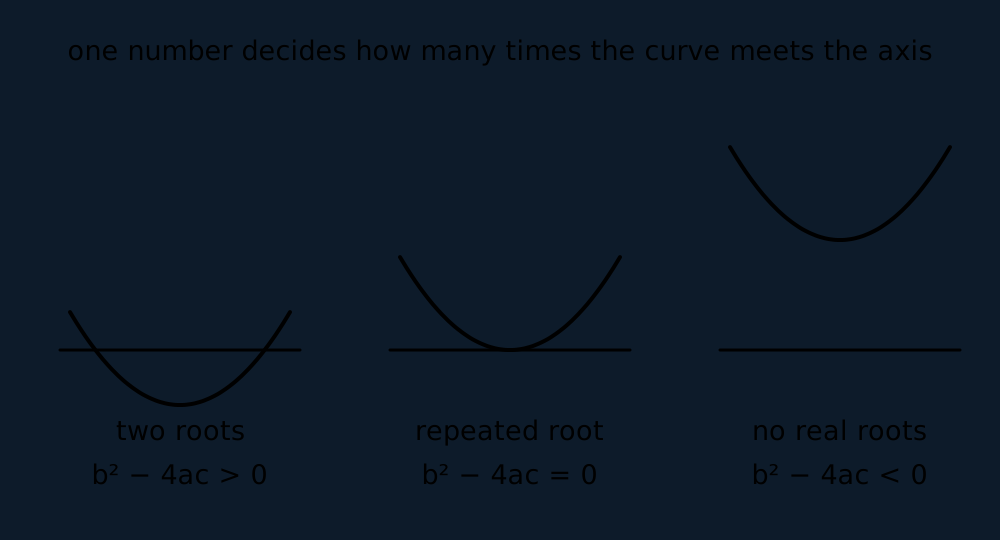
- Quadratics in their three forms, completing the square when the leading coefficient is not 1, and the discriminant as a count of real roots.
- One linear equation with one quadratic, and linear, quadratic and fractional inequalities solved from a sketch and written in set notation.
- Algebraic division, the factor theorem, and a cubic factorised completely from one root that has been found.
- Sketching from factors, the reciprocal graphs with their asymptotes, direct and inverse proportion, and the four transformations of y = f(x).
- Functions: domain and range, composition in the right order, inverses, and the modulus of a linear function.
- Partial fractions for distinct and repeated linear factors, and choosing a function family to model a situation and saying where it fails.
The results it turns on
- am/n = (the nth root of a)m
- the fractional index, with the root taken before the power
- x = (−b ± √(b² − 4ac))/2a, with discriminant b² − 4ac
- solving a quadratic, and counting how many real roots it has
- ax² + bx + c = a(x + b/2a)² + c − b²/4a
- the completed square, which names the vertex
- f(a) = 0 means (x − a) is a factor of f(x)
- the factor theorem, with x = b/a for a factor (ax - b)
- fg(x) means g applied first, and f−1 reflects f in y = x
- composition and inversion of functions
- A/(x − p) + B/(x − q) + C/(x − q)²
- the partial fraction template when one linear factor is repeated
Where it usually goes wrong
- The wording of a discriminant condition decides the inequality sign. Real roots includes the repeated case and takes at least; distinct real roots excludes it and takes strictly greater.
- Multiplying an inequality by a quantity whose sign is unknown is unsafe. Multiply by its square, or move everything to one side and sketch.
- Transformations outside the bracket act on y and do what they say. Inside the bracket they act on x and do the opposite, so f(x + 3) shifts left.
- The domain of an inverse is the range of the original function. Stating it is a separate mark from finding the rule.
Where to start
Indices and surds first, then quadratics, since almost everything after them leans on completing the square and the discriminant. Simultaneous equations and inequalities, then polynomials, then graphs and transformations before functions. Leave partial fractions and modelling until Year 13, where the rest of the course starts calling on them.