Maths › Complex numbers
Complex numbers
The number line grows a second dimension. Every quadratic gains its roots, algebra turns into geometry on the Argand diagram, and multiplication becomes rotation.
Further Maths · 4 topics.
- Complex arithmetic and the Argand diagram
- Modulus, argument and loci
- De Moivre's theorem and trigonometric identities
- Roots of unity and complex roots
What complex numbers covers
The number line grows a second dimension. Every quadratic gains its roots, algebra turns into geometry on the Argand diagram, and multiplication becomes a rotation with a scaling. This is Core Pure content, examinable on both compulsory papers of 9FM0, and it returns in further algebra, in differential equations and in the Further Pure 2 work on the complex plane.
The main ideas
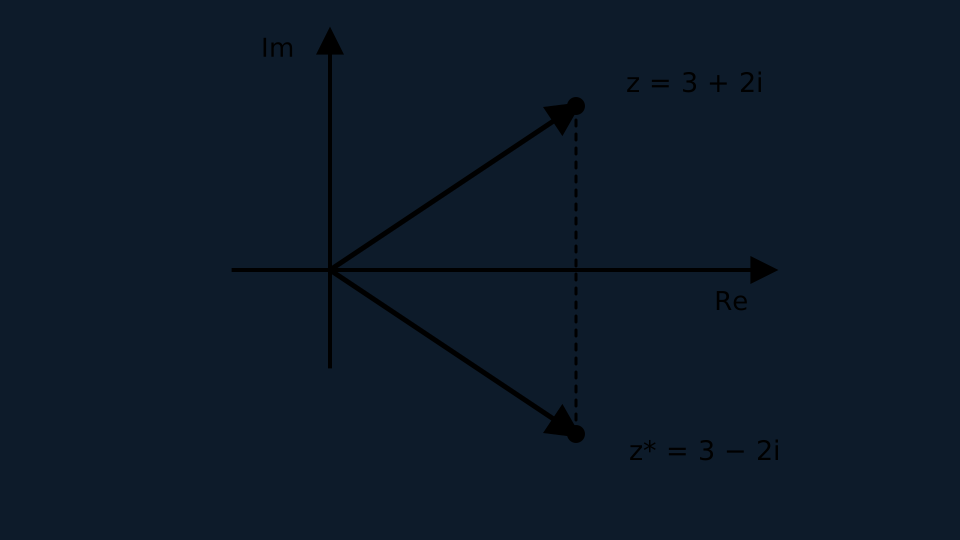
- The imaginary unit, quadratics with a negative discriminant, and conjugates as a reflection in the real axis.
- Addition and multiplication as ordinary algebra, and division by multiplying top and bottom by the conjugate of the denominator.
- The Argand diagram, with points given as coordinates and addition read as vectors.
- Modulus and argument, with the argument reported in radians and read from a sketch, then modulus-argument form for products and quotients.
- Loci and regions: circles, perpendicular bisectors, half-lines, and shading an inequality with the boundary convention marked.
- De Moivre's theorem, the exponential form, and multiple-angle identities got by binomial expansion and equating parts.
- The nth roots of unity and of any non-zero complex number, spaced evenly round a circle.
The results it turns on
- i² = −1
- the one new rule; the rest is ordinary algebra
- (x + yi)(x − yi) = x² + y²
- the real denominator a division is cleared with
- z = r(cos θ + i sin θ) = reiθ
- modulus-argument form and exponential form
- zⁿ = rⁿ(cos nθ + i sin nθ)
- De Moivre's theorem: power the modulus, multiply the argument
- |z − a| = r, |z − a| = |z − b|, arg(z − a) = θ
- the circle, the perpendicular bisector and the half-line
- root the modulus, divide the argument by n, then space by 2π/n
- the n roots of zⁿ = w for non-zero w
Where it usually goes wrong
- The centre of a circle locus is read from what is subtracted, so |z - (2 + i)| = 3 has centre 2 + i rather than -2 - i.
- De Moivre's theorem applies to a number written in modulus-argument or exponential form. A number left as x + yi has to be converted first.
- A half-line locus leaves out its endpoint, and saying so is part of describing it.
- For non-zero w the equation zⁿ = w has n distinct roots, so count them before finishing and reduce every argument back into the principal range.
Where to start
Arithmetic and the Argand diagram first, then modulus, argument and loci, which is the longest of the four lessons and the most heavily sketched. De Moivre's theorem next, and revise the binomial theorem before it. Roots of unity last, since it puts the geometry and the theorem together.