Maths › Integration
Integration
Differentiation run backwards, and then somewhere new. Antiderivatives recover a curve from its gradient, definite integrals measure the area underneath, and by the end the same machinery solves differential equations.
Years 12-13 · 7 topics.
- Integration as antidifferentiation
- Definite integrals and areas
- Integrating standard functions
- Integration by substitution and by parts
- Integrating rational functions
- Areas, parametric curves and the limit of a sum
- Solving differential equations
What integration covers
Differentiation run backwards, and then somewhere new. Antiderivatives recover a curve from its gradient function, definite integrals measure the area underneath, and by the end the same machinery solves separable differential equations. Partial fractions from Algebra and the compound angle identities from Trigonometry are both assumed here.
The main ideas
- Antidifferentiation with a constant, and recovering a curve from its gradient function together with one known point.
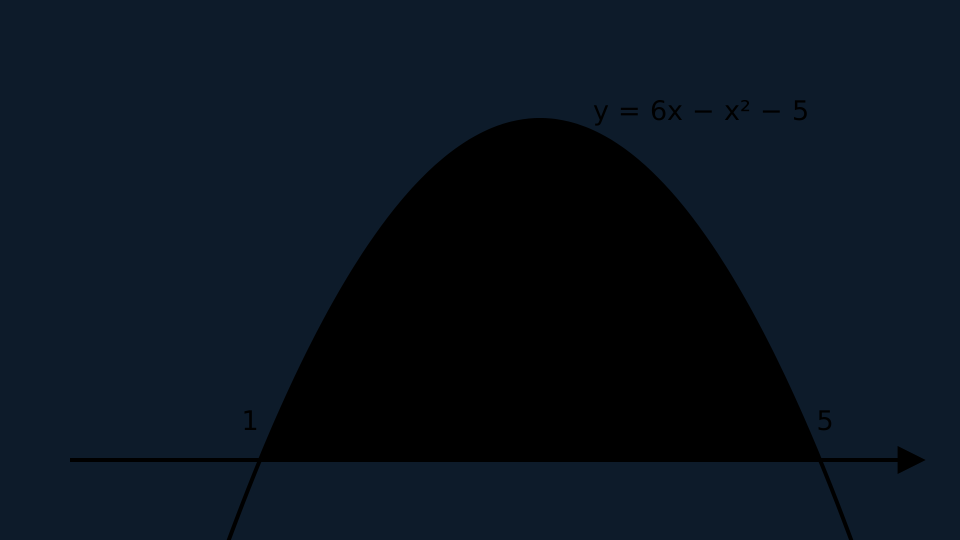
- Definite integrals by the square-bracket routine, areas under curves and between a curve and a line, and regions below the axis split at the roots.
- The standard integrals of the exponential, 1/x, sin kx, cos kx and sec² kx, with squared trigonometric integrands reshaped by identity first.
- Reverse chain rule patterns spotted at sight, substitution with the limits converted alongside the variable, and integration by parts including two passes and the integral of ln x.
- Rational integrands split by partial fractions, and telling a logarithm from a negative power by looking at the numerator.
- The area between two curves, areas under parametric curves, and the integral read as the limit of a sum of thin strips.
- Separable first order differential equations, a particular solution fixed by a condition, and interpretation in context.
The results it turns on
- ∫xⁿ dx = xn+1/(n + 1) + c, for n ≠ −1
- the reversed power rule
- ∫(1/x) dx = ln|x| + c
- the case the power rule leaves out
- ∫f'(x)/f(x) dx = ln|f(x)| + c
- the pattern that produces a logarithm
- ∫u dv = uv − ∫v du
- integration by parts, differentiating the factor that simplifies
- area = ∫(top − bottom) dx between the intersections
- the region between two curves, in one integral
- parametric area = ∫y (dx/dt) dt, with t-limits
- an area under a curve given by a parameter
Where it usually goes wrong
- Definite integrals are signed and areas are not. Sketch first, split at the roots, and add the sizes of the pieces.
- In a substitution the integrand, the dx and the limits all convert together. Limits left in terms of x are the usual reason a definite integral comes out wrong.
- In parts, differentiate the factor that simplifies. If the new integral is harder than the old one, the roles were the wrong way round.
- The constant of integration arrives when the integrals happen, not after rearranging, and through an exponentiation it becomes a multiplier rather than an addition.
Where to start
Antidifferentiation and definite integrals first, since the area work needs both. Standard functions next, then substitution and parts, which assume the chain and product rules. Rational functions after partial fractions is secure, then areas and parametric curves. Differential equations last, because that lesson uses everything above it.