Maths › Mechanics
Mechanics
The other half of Paper 3. The physics of moving and balancing things, run entirely on the Pure toolkit: vectors point the forces, calculus drives the motion.
Years 12-13 · 9 topics.
- Modelling, quantities and units
- Kinematics with constant acceleration
- Kinematics with variable acceleration
- Forces and Newton's laws
- Connected particles and pulleys
- Projectiles
- Friction and inclined planes
- Statics of a particle
- Moments
What mechanics covers
The other half of Paper 3 of 9MA0, run entirely on the Pure toolkit. Vectors point the forces, calculus drives the motion, and every question starts with a model and a declared positive direction. Nine lessons, and the diagram at the top of a solution is usually worth a mark before any algebra appears.
The main ideas
- Modelling vocabulary with the simplification each word allows, SI units, and the habit of fixing a positive direction before calculating.
- Motion graphs read as gradients and areas, and the five constant-acceleration equations with their condition attached.
- Variable acceleration by differentiating and integrating, in one dimension and in i-j form, with constants fixed by stated conditions.
- Free body diagrams, F = ma along a declared direction, resolving a force at an angle, and equilibrium as the case where the acceleration is zero.
- Connected particles and smooth pulleys: a system equation for the acceleration and a single-particle equation for the tension.
- Projectiles as two motions sharing one time, giving time of flight, range, greatest height and the equation of the path.
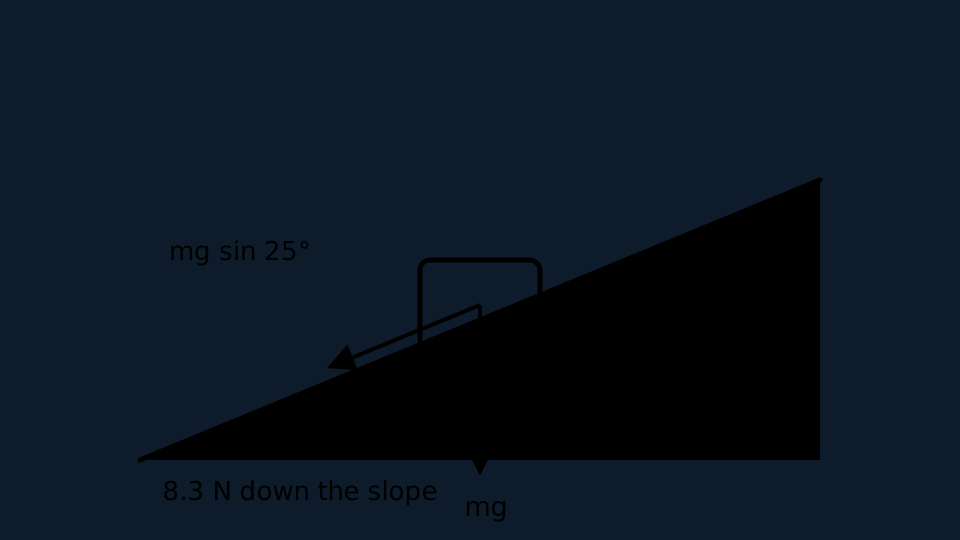
- Friction with F at most mu R, motion on inclined planes, statics of a particle, and moments for beams, non-uniform rods and tilting.
The results it turns on
- v = u + at, s = ut + ½at², v² = u² + 2as, s = ½(u + v)t
- four of the five suvat equations, valid while the acceleration is constant
- v = dx/dt and a = dv/dt, with integration reversing each
- kinematics where the acceleration varies
- F = ma
- Newton's second law, written along a declared direction
- u cos θ horizontally, u sin θ vertically with a = −g
- a launch velocity resolved for a projectile
- F ≤ μR, with equality in limiting equilibrium or while sliding
- the friction model
- moment = force × perpendicular distance
- moments taken about a chosen pivot, with a declared sense
Where it usually goes wrong
- The suvat equations apply while the acceleration is constant, so a motion that changes stage has to be split at the join and no equation may be run across it.
- The normal reaction is not generally the weight. Resolve perpendicular to the surface and see what comes out, especially when an applied force has a vertical component.
- Landing on level ground means the vertical displacement is zero, not the vertical velocity. Landing below the launch point makes that displacement negative, and the sign has to survive.
- Using F = mu R for an object at rest partway through a question is the error examiners look for first. Equality holds in limiting equilibrium or during sliding.
Where to start
Modelling and units first, then constant acceleration, then variable acceleration once calculus is fluent. Forces and Newton's laws before connected particles. Projectiles once suvat is secure, then friction and inclined planes, then statics. Moments is self-contained and can go last.