Maths › Trigonometry
Trigonometry
The mathematics of triangles, and of anything that repeats. Two rules solve every triangle there is, the unit circle turns angles into coordinates, and identities reshape trig statements until an equation gives in.
Years 12-13 · 6 topics.
- Triangles and the sine and cosine rules
- Trigonometric graphs and equations
- Radians, arcs and small angles
- Reciprocal and inverse trigonometric functions
- Compound angles and the harmonic form
- Trigonometric modelling
What trigonometry covers
The mathematics of triangles, and of anything that repeats. Two rules solve any triangle, the unit circle turns an angle into a pair of coordinates, and a stock of identities reshapes a statement until an equation can be solved. The compound angle work here supplies the identities that later integration depends on, and radians are the measure every calculus result assumes.
The main ideas
- The sine and cosine rules with sides and angles paired correctly, the ambiguous case, and the area from two sides and the included angle.
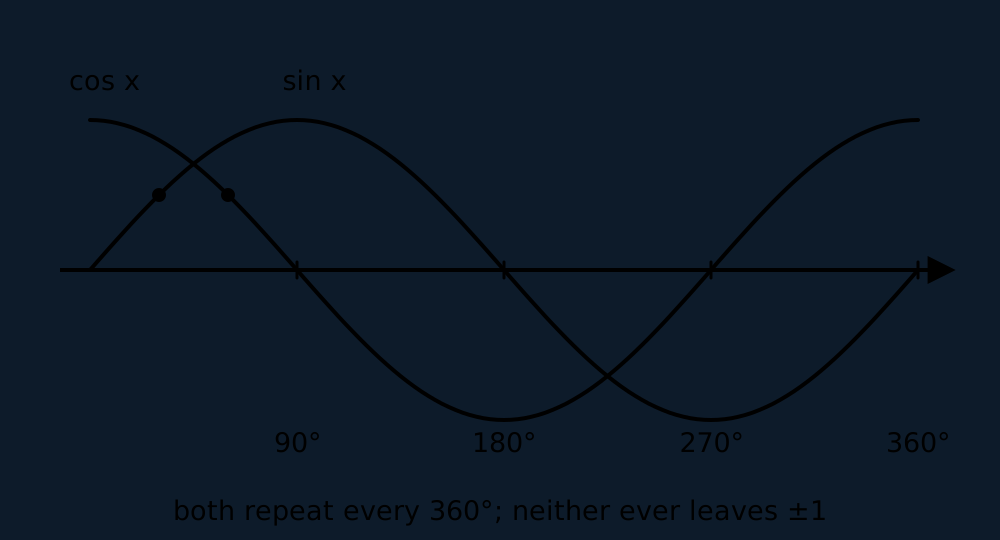
- Graphs, symmetry and periodicity, exact values at the standard angles, and solving in a given interval by widening, substituting and translating back.
- Radians, arc length, sector and segment areas, and the small-angle approximations with their radian condition stated.
- The reciprocal ratios with their graphs and asymptotes, the two Pythagorean identities got by dividing, and the inverse functions with restricted ranges.
- Compound angle formulae, the double angle formulae derived by setting B = A, the three forms of cos 2A, and identity proofs worked down one side.
- The harmonic form, used for solving equations and for reading off maxima and minima without differentiating.
- Periodic modelling in radians, with centre line, amplitude, period and phase each read from its own place in the formula.
The results it turns on
- a/sin A = b/sin B = c/sin C, and a² = b² + c² − 2bc cos A
- the sine rule for opposite pairs, the cosine rule otherwise
- sin²x + cos²x = 1
- the Pythagorean identity
- sec²x = 1 + tan²x, and cosec²x = 1 + cot²x
- the two identities got by dividing the first one
- s = rθ, and A = ½r²θ
- arc length and sector area, with theta in radians
- cos 2A = cos²A − sin²A = 2cos²A − 1 = 1 − 2sin²A
- three forms, one of which suits whatever ratio a question already uses
- a sin θ + b cos θ = R sin(θ + α), with R = √(a² + b²)
- the harmonic form, whose extremes are plus and minus R
Where it usually goes wrong
- When the unknown sits inside a bracket, the interval has to be widened to match the substituted angle before any solutions are collected. More marks go missing at that step than anywhere else in the unit.
- Dividing an equation by cos x or sin x can remove solutions, since either can be zero. Move everything to one side and factorise instead.
- The small-angle approximations hold with the angle in radians. The condition is not printed in the booklet, so saying it in words is often worth a mark.
- The notation sin⁻¹ means arcsin and 1/sin means cosec, and the two are different functions.
Where to start
Triangles first, then graphs and equations, which set the solving routine the rest of the unit reuses. Radians before anything in calculus. Reciprocal and inverse functions next, then compound angles with the harmonic form after them, and modelling last.