Maths › Coordinate geometry
Coordinate geometry
Algebra pointed at pictures. A line is pinned by one point and a gradient, a circle by its centre and radius, and the circle theorems of GCSE come back as short coordinate calculations.
Years 12-13 · 3 topics.
What coordinate geometry covers
Algebra pointed at pictures. A line is pinned by one point and a gradient, a circle by its centre and radius, and a parametric curve by a parameter that behaves like a clock. The unit is short and heavily sketch-based, and its parametric work reappears in differentiation, integration and projectile modelling.
The main ideas
- A line from a point and a gradient, or from two points, given in both of the forms the specification asks for.
- Parallel and perpendicular conditions, with the product of gradients written out rather than asserted.
- The circle in centre-radius form and in general form, moved between by completing the square in x and in y separately.
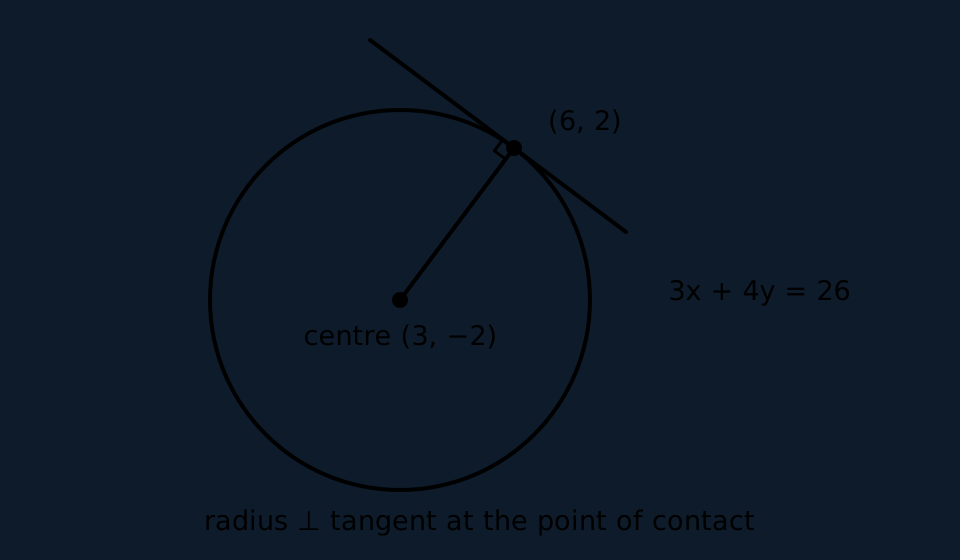
- Three circle properties: radius perpendicular to tangent, the perpendicular from the centre bisecting a chord, and a right angle on the circle naming a diameter.
- A line substituted into a circle, with the discriminant naming which of the three cases you are in, and the circle through three given points.
- Parametric curves traced by increasing the parameter, converted to cartesian form by substitution or by a trigonometric identity.
The results it turns on
- y − y₁ = m(x − x₁), and ax + by + c = 0
- the two forms a line answer may be demanded in
- m₁m₂ = −1
- the condition for two lines to be perpendicular
- (x − a)² + (y − b)² = r²
- the circle with centre (a, b) and radius r
- x² + y² + 2fx + 2gy + c = 0, centre (−f, −g), r² = f² + g² − c
- the general form and what it hides
- (half the chord)² = r² − d²
- chord length, with d the distance from the centre to the line
- x = 3 cos t with y = 3 sin t gives x² + y² = 9
- eliminating a parameter through a trigonometric identity
Where it usually goes wrong
- The signs in the centre-radius form reverse. (x − 3)² puts the centre at x = +3, and the radius is the square root of the right-hand side rather than the number itself.
- Tangent questions here are gradient questions. Radius gradient, negative reciprocal, point-gradient form. Calculus is not required and costs time when it appears.
- A parametrisation may reach only part of the cartesian curve, so the domain of the parameter and any missing piece both have to be stated. That restriction carries its own mark.
Where to start
Straight lines first, since the circle work uses gradients throughout. Circles next, taking completing the square slowly because both signs and the radius depend on it. Parametric equations last, and revisit it once parametric differentiation has been covered.