Maths › Differentiation
Differentiation
Where change gets measured. Shrinking chords turn into tangents, the gradient of a curve becomes a function in its own right, and with it come maxima, minima and the machinery behind every optimisation in the course.
Years 12-13 · 7 topics.
- The derivative from first principles
- Differentiating powers of x
- Tangents, turning points and curve behaviour
- Differentiating trig, exponentials and logs
- The product, quotient and chain rules
- Implicit and parametric differentiation
- Rates of change and building differential equations
What differentiation covers
Where change gets measured. Shrinking chords become tangents, the gradient of a curve becomes a function in its own right, and with it come maxima, minima and every optimisation on the course. The unit runs across both years and both Pure papers, and its later lessons are what integration, numerical methods and mechanics all assume.
The main ideas
- The derivative as the limit of chord gradients, first principles for small powers, sketching a gradient function, and the second derivative.
- The power rule for any rational n, with roots, reciprocals, products and quotients rewritten as powers before it is applied.
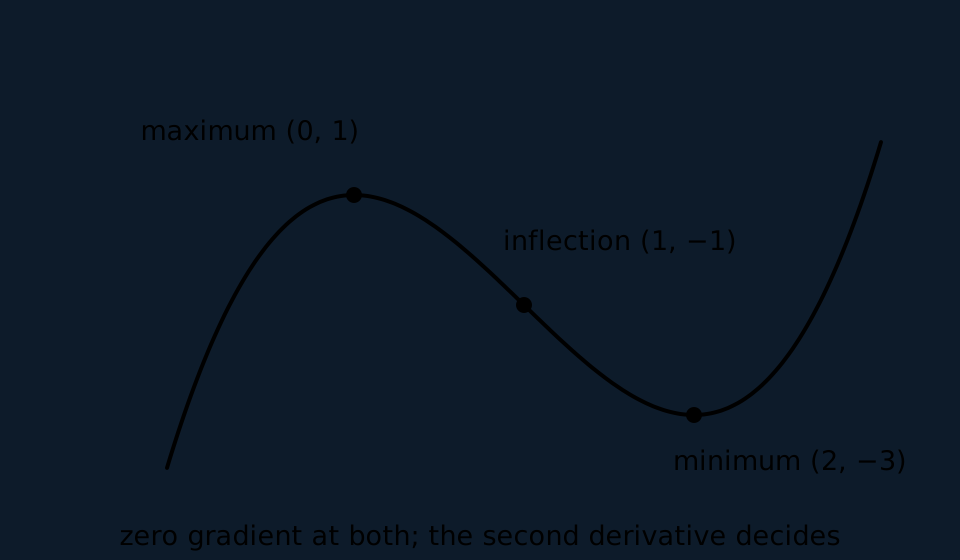
- Tangents and normals, stationary points classified by the second derivative, increasing and decreasing intervals, and convex and concave sections.
- Practical maximisation and minimisation, with the domain stated and any stationary point outside it rejected for a reason.
- The standard derivatives of sin kx, cos kx, tan kx, the exponentials and ln x, with the first-principles proofs for sine and cosine.
- The chain, product and quotient rules, the booklet derivatives of sec, cosec and cot, and nested expressions taken one rule per line.
- Implicit and parametric differentiation, connected rates of change, and building a differential equation from a sentence about a rate.
The results it turns on
- f'(x) = the limit of (f(x + h) − f(x))/h as h → 0
- the derivative from first principles
- the derivative of xⁿ is nxn−1
- the power rule, for any rational n
- sin kx → k cos kx, cos kx → −k sin kx, ekx → kekx, ln x → 1/x
- the standard shelf, valid with angles in radians
- (uv)' = u'v + uv', and (u/v)' = (u'v − uv')/v²
- the product rule and the ordered quotient rule
- dy/dx = (dy/du)(du/dx)
- the chain rule, and the route through a connected rate of change
- dy/dx = (dy/dt)/(dx/dt)
- the gradient of a parametric curve
Where it usually goes wrong
- A second derivative of zero decides nothing on its own. An inflection needs a sign change, so test either side or fall back on the gradient.
- The trig derivatives hold in radians. In degrees they are wrong by a factor, and the standard results assume radians throughout.
- Differentiating a power of any base other than e brings down a factor of ln a as well as the k. Dropping it is the standard lost mark on that lesson.
- In implicit differentiation every y-term picks up dy/dx through the chain rule, and any xy term needs the product rule, so collect and factorise before dividing.
Where to start
First principles first, then the power rule, then tangents and turning points, which is where most of the Year 12 marks sit. The standard functions next, then the three rules, since implicit and parametric work both use them. Rates of change and building differential equations close the unit and lead straight into integration.